

Here, we’ve presented essays on “1857 Revolt” in 150, 200, 250 & 500 word samples. All the essays will be helpful for students of all classes i.e. 1, 2, 3, 4, 5, 6, 7, 8, 9, 10, 11 & class 12.
Essay on 1857 Revolt in 150 Words
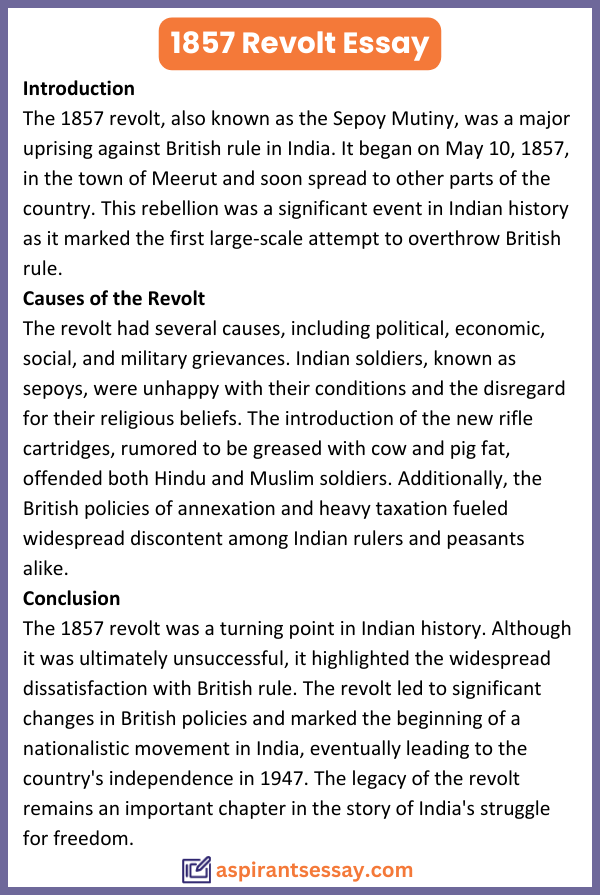
Introduction
The 1857 revolt, also known as the Sepoy Mutiny, was a major uprising against British rule in India. It began on May 10, 1857, in the town of Meerut and soon spread to other parts of the country. This rebellion was a significant event in Indian history as it marked the first large-scale attempt to overthrow British rule.
Causes of the Revolt
The revolt had several causes, including political, economic, social, and military grievances. Indian soldiers, known as sepoys, were unhappy with their conditions and the disregard for their religious beliefs. The introduction of the new rifle cartridges, rumored to be greased with cow and pig fat, offended both Hindu and Muslim soldiers. Additionally, the British policies of annexation and heavy taxation fueled widespread discontent among Indian rulers and peasants alike.
Conclusion
The 1857 revolt was a turning point in Indian history. Although it was ultimately unsuccessful, it highlighted the widespread dissatisfaction with British rule. The revolt led to significant changes in British policies and marked the beginning of a nationalistic movement in India, eventually leading to the country’s independence in 1947. The legacy of the revolt remains an important chapter in the story of India’s struggle for freedom.
1857 Revolt Essay in 200 Words
Introduction
The 1857 revolt, also known as the Sepoy Mutiny or the First War of Indian Independence, was a significant uprising against British rule in India. It began on May 10, 1857, in the town of Meerut when Indian soldiers, known as sepoys, rebelled against their British officers. The revolt quickly spread to other regions, including Delhi, Kanpur, and Lucknow, marking a pivotal moment in the struggle against colonial rule.
Causes of the Revolt
The revolt was driven by multiple factors, including political, economic, social, and military grievances. Indian rulers and princes were angered by the British policy of annexation, which threatened their sovereignty. Economic hardships, such as heavy taxation and the destruction of traditional industries, caused widespread discontent among peasants and artisans. Socially, the British showed little respect for Indian customs and traditions. Militarily, the introduction of the new Enfield rifle, rumored to use cartridges greased with cow and pig fat, deeply offended Hindu and Muslim soldiers, sparking the initial mutiny.
Key Events
Key events of the revolt included the capture of Delhi by the rebels, led by Bahadur Shah II, and significant battles in Kanpur, Lucknow, and Jhansi. Figures like Rani Lakshmibai of Jhansi and Tatya Tope became prominent leaders in the fight against British forces. Despite early successes, the rebellion lacked coordination and was eventually suppressed by the British by mid-1858. The capture and execution of many rebel leaders marked the end of the uprising.
Conclusion
The 1857 revolt was a crucial event in Indian history, despite its failure to end British rule. It exposed the vulnerabilities of British authority and highlighted the widespread dissatisfaction among Indians. In response, the British government took direct control of India, ending the rule of the East India Company. The revolt also sowed the seeds of Indian nationalism, inspiring future generations to continue the struggle for independence, which was finally achieved in 1947.
Essay Writing on 1857 Revolt in 250 Words
Introduction
The 1857 revolt, also known as the Sepoy Mutiny or the First War of Indian Independence, was a watershed moment in Indian history. It began on May 10, 1857, in Meerut when Indian soldiers, or sepoys, rebelled against their British officers. The revolt soon spread to major regions, including Delhi, Kanpur, and Lucknow, marking the first significant challenge to British rule in India.
Causes of the Revolt
The revolt was fueled by a variety of political, economic, social, and military grievances. Politically, the British policy of annexation, particularly the Doctrine of Lapse, threatened the sovereignty of Indian rulers. Economically, heavy taxation and the destruction of traditional industries caused widespread poverty and resentment among peasants and artisans. Socially, the British showed little respect for Indian customs and traditions, imposing their own cultural norms. Militarily, the introduction of the new Enfield rifle, rumored to be greased with cow and pig fat, offended both Hindu and Muslim soldiers, sparking the initial mutiny.
Key Events and Leaders
Key events of the revolt included the capture of Delhi by the rebels, where they proclaimed Bahadur Shah II as the emperor of India. Significant battles occurred in Kanpur, led by Nana Sahib, and in Lucknow, where Begum Hazrat Mahal played a crucial role. Rani Lakshmibai of Jhansi and Tatya Tope became prominent leaders, inspiring many to join the rebellion. Despite early successes, the revolt lacked centralized coordination and resources, leading to its suppression by mid-1858.
British Response and Repercussions
In response to the revolt, the British government dissolved the East India Company and took direct control of India through the Government of India Act 1858. They implemented reforms to placate Indian rulers and elites, hoping to prevent future uprisings. Military changes were made to ensure better control over Indian soldiers, and efforts were made to respect Indian social and religious customs to some extent.
Conclusion
The 1857 revolt was a pivotal event in the history of India. Although it did not succeed in ending British rule, it exposed the vulnerabilities and injustices of colonial administration. The rebellion led to significant changes in British policies and governance in India, marking the end of the East India Company’s rule. Moreover, it sowed the seeds of Indian nationalism, inspiring future generations to continue the fight for independence, which was ultimately achieved in 1947.
Writing Essay on 1857 Revolt in 500 Words
Introduction
The 1857 revolt, also known as the Sepoy Mutiny, the Indian Rebellion of 1857, or the First War of Indian Independence, was a seminal event in the history of colonial India. It began on May 10, 1857, in Meerut when Indian soldiers, or sepoys, serving in the British East India Company’s army, rose up against their British officers. The revolt quickly spread to other regions, including Delhi, Kanpur, and Lucknow, becoming the largest and most significant uprising against British rule in the 19th century.
Causes of the Revolt
The causes of the revolt were multifaceted, involving political, economic, social, and military grievances. Politically, the British policy of annexation, particularly the Doctrine of Lapse, allowed them to annex any princely state where the ruler did not have a direct heir. This policy threatened the sovereignty of many Indian rulers and created widespread discontent. Economically, heavy taxation and the destruction of traditional industries, such as textiles, led to widespread poverty and unemployment among Indian artisans and peasants. Socially, the British showed little respect for Indian customs and traditions, imposing their own cultural norms and often treating Indians as inferior.
Military Grievances
One of the immediate causes of the revolt was the introduction of the new Enfield rifle. The cartridges for this rifle were rumored to be greased with cow and pig fat, offending both Hindu and Muslim soldiers. For Hindus, the cow is sacred, while for Muslims, the pig is considered unclean. The requirement to bite off the ends of these greased cartridges before loading the rifles was seen as a direct affront to their religious beliefs. This act of insensitivity by the British authorities ignited the already smoldering discontent among the sepoys.
Spread of the Revolt
The revolt spread rapidly across northern and central India. In Delhi, the rebels seized control and declared Bahadur Shah II, the last Mughal emperor, as their leader. In Kanpur, Nana Sahib led the revolt, while in Lucknow, Begum Hazrat Mahal took charge. Rani Lakshmibai of Jhansi and Tatya Tope emerged as prominent leaders in the central region, fighting fiercely against the British. Despite early successes, the rebellion suffered from a lack of centralized leadership and coordination, which ultimately contributed to its failure.
Key Battles and Leaders
Several key battles defined the course of the revolt. The Siege of Delhi saw fierce fighting between the rebels and British forces, with the city changing hands multiple times before the British finally recaptured it. In Kanpur, the rebels initially defeated the British but later faced brutal retribution when British forces retook the city. The defense of Lucknow, led by British Resident Sir Henry Lawrence and later Colin Campbell, became a symbol of British resilience. The heroic defense by Rani Lakshmibai at Jhansi became legendary, as did her eventual martyrdom in battle.
British Response and Repercussions
In the aftermath of the revolt, the British government took direct control of India, dissolving the East India Company through the Government of India Act 1858. This act marked the beginning of the British Raj, with India coming under the direct administration of the British Crown. The British implemented several reforms to pacify Indian rulers and elites, aiming to prevent future uprisings. Military restructuring ensured better control over Indian soldiers, and efforts were made to show greater respect for Indian social and religious customs.
Conclusion
The 1857 revolt was a pivotal event in Indian history, despite its failure to end British rule. It exposed the deep-seated grievances and vulnerabilities within the colonial administration. The rebellion led to significant changes in British policies and governance in India, ending the era of the East India Company’s rule and marking the beginning of direct British governance. Importantly, the revolt sowed the seeds of Indian nationalism, inspiring future generations to continue the struggle for independence, which was ultimately achieved in 1947. The legacy of the 1857 revolt remains a crucial chapter in the story of India’s fight for freedom, symbolizing resistance and the quest for self-determination.