

Here, we’ve presented essays on “Education” in 150, 200, 250 & 500 word samples. All the essays will be helpful for students of all classes i.e. 1, 2, 3, 4, 5, 6, 7, 8, 9, 10, 11 & class 12.
Essay on Education in 150 Words
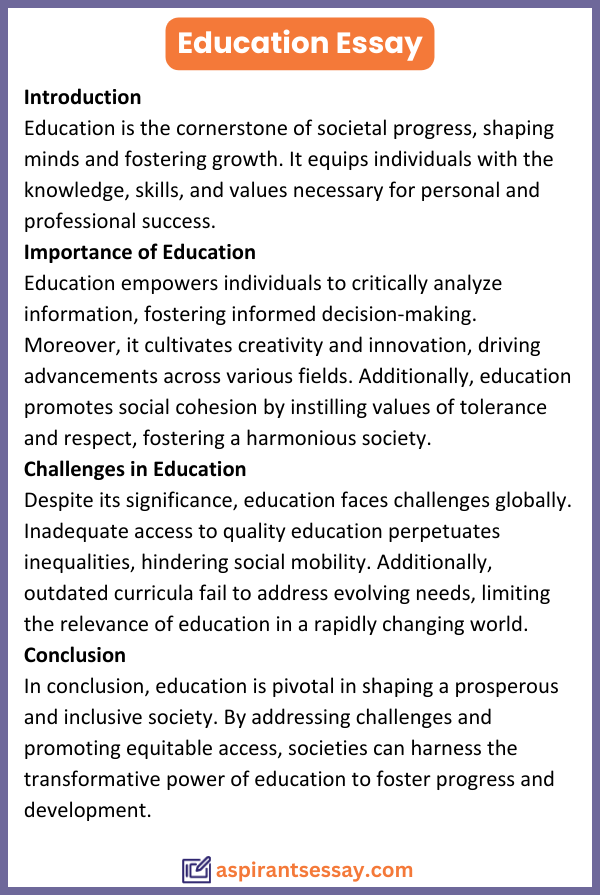
Introduction
Education is the cornerstone of societal progress, shaping minds and fostering growth. It equips individuals with the knowledge, skills, and values necessary for personal and professional success.
Importance of Education
Education empowers individuals to critically analyze information, fostering informed decision-making. Moreover, it cultivates creativity and innovation, driving advancements across various fields. Additionally, education promotes social cohesion by instilling values of tolerance and respect, fostering a harmonious society.
Challenges in Education
Despite its significance, education faces challenges globally. Inadequate access to quality education perpetuates inequalities, hindering social mobility. Additionally, outdated curricula fail to address evolving needs, limiting the relevance of education in a rapidly changing world.
Conclusion
In conclusion, education is pivotal in shaping a prosperous and inclusive society. By addressing challenges and promoting equitable access, societies can harness the transformative power of education to foster progress and development.
Education Essay in 200 Words
Introduction
Education serves as the bedrock of societal advancement, nurturing individuals to realize their full potential and contribute meaningfully to their communities. Its multifaceted role encompasses the transmission of knowledge, development of critical thinking skills, and cultivation of values essential for holistic growth.
The Role of Education in Personal Development
Education empowers individuals with the knowledge and skills necessary to navigate life’s challenges effectively. It fosters intellectual curiosity, encouraging lifelong learning and self-improvement. Furthermore, education nurtures essential life skills such as communication, problem-solving, and adaptability, laying the groundwork for personal success and fulfillment.
Education as a Catalyst for Societal Progress
At the societal level, education serves as a catalyst for progress and development. It equips communities with the expertise needed to address complex issues and drive innovation across various sectors. Moreover, education promotes social cohesion by fostering understanding and empathy, contributing to a more harmonious and inclusive society.
Challenges Facing Education Systems
However, education systems worldwide grapple with various challenges that hinder their effectiveness. Inequitable access to quality education perpetuates disparities, limiting opportunities for marginalized populations. Additionally, outdated pedagogical approaches and inadequate resources impede the delivery of relevant and impactful learning experiences.
Conclusion
In conclusion, education is indispensable in fostering individual growth and societal advancement. By addressing challenges such as inequity and outdated practices, societies can unlock the full potential of education to create a brighter and more equitable future for all.
Essay Writing on Education in 250 Words
Introduction
Education stands as the cornerstone of progress, serving as a potent tool for individual empowerment and societal transformation. In India, where approximately 315 million children were affected by school closures during the COVID-19 pandemic in 2020, the importance of education as a vehicle for resilience and recovery cannot be overstated.
The Transformative Power of Education
Education transcends mere instruction, shaping minds and molding futures. According to UNESCO, each additional year of schooling correlates with a 10% increase in an individual’s earnings. Moreover, education is a potent weapon against poverty, with projections suggesting that if all students in low-income countries acquired basic reading skills, 171 million people could be lifted out of poverty.
Addressing Educational Inequality
Yet, in India, educational inequality remains a pressing issue. Despite significant progress in enrollment rates, disparities persist across gender, socioeconomic status, and geographic location. According to the Annual Status of Education Report (ASER) 2020, only 16% of children in grade 3 in rural India could read grade 2 level text. Bridging these gaps requires concerted efforts to improve access to quality education and address underlying socio-economic barriers.
The Role of Technology in Education
Technology has emerged as a potent tool in expanding educational access and enhancing learning outcomes. In India, initiatives like the National Education Policy 2020 emphasize the integration of technology in education delivery. Digital platforms and e-learning resources have the potential to reach remote and marginalized communities, democratizing access to quality education.
Challenges on the Educational Horizon
However, challenges loom on the educational horizon. Inadequate infrastructure, teacher shortages, and the digital divide pose significant obstacles to realizing the full potential of education in India. Addressing these challenges necessitates comprehensive reforms, investment in human capital, and innovative approaches to pedagogy.
Conclusion
In conclusion, education serves as the cornerstone of India’s development journey, offering a pathway to economic prosperity, social equity, and individual empowerment. By prioritizing inclusive and quality education, India can unlock the potential of its vast human capital and chart a course towards a brighter and more equitable future.
Writing an Essay on Education in 500 Words
Introduction
Education is the key to unlocking human potential and driving societal progress. In India, with a population exceeding 1.3 billion and a significant youth demographic, the state of education holds immense importance. According to UNESCO, India has made significant strides in improving enrollment rates, with primary school enrollment reaching 99.2% in 2019. However, challenges such as educational inequality, quality of education, and technological integration persist, underscoring the need for comprehensive reforms.
The Significance of Education
Education transcends the confines of classrooms, empowering individuals with knowledge, skills, and values essential for personal and professional success. Beyond economic benefits, education fosters critical thinking, creativity, and social cohesion. Studies show that educated individuals are more likely to engage in civic activities, contribute to economic growth, and lead healthier lives. Moreover, education plays a pivotal role in achieving Sustainable Development Goals (SDGs), including poverty eradication, gender equality, and environmental sustainability.
Educational Landscape in India
India’s educational landscape is vast and diverse, comprising a mix of government-run schools, private institutions, and alternative learning centers. While strides have been made in expanding access to education, disparities persist across rural-urban divides, gender lines, and socio-economic backgrounds. According to the National Statistical Office, in 2017-2018, the Gross Enrollment Ratio (GER) for higher education stood at 26.3%, indicating room for improvement in tertiary education access.
Challenges in Education
Despite progress, India faces multifaceted challenges in its education system. Quality of education remains a significant concern, with learning outcomes often falling short of expectations. The Annual Status of Education Report (ASER) highlights the prevalence of learning deficits among Indian students, with a significant proportion unable to read or perform basic mathematical operations at grade-level proficiency. Additionally, inadequate infrastructure, teacher shortages, and outdated pedagogical methods hinder the delivery of quality education.
Digital Divide and Technological Integration
The digital revolution presents both opportunities and challenges for education in India. While technological innovations have the potential to revolutionize learning experiences and expand access to remote and marginalized communities, the digital divide remains a stark reality. According to the National Sample Survey Office (NSSO), only 23.8% of Indian households had internet access in 2017-2018, exacerbating inequalities in educational access and learning outcomes.
Government Initiatives and Policy Reforms
Recognizing the critical importance of education, the Indian government has launched several initiatives and policy reforms to address systemic challenges. The National Education Policy (NEP) 2020 aims to overhaul the education system, focusing on holistic development, flexibility, and innovation. Moreover, schemes like Sarva Shiksha Abhiyan (SSA) and Rashtriya Madhyamik Shiksha Abhiyan (RMSA) seek to improve access, equity, and quality of education across all levels.
Community Engagement and Stakeholder Participation
Education reform cannot succeed in isolation; it requires the active engagement of communities, stakeholders, and civil society organizations. Initiatives like community-led schools, parent-teacher associations, and vocational training programs empower local communities to take ownership of educational outcomes and contribute to sustainable development.
Conclusion
In conclusion, education holds the key to India’s aspirations for inclusive growth, social cohesion, and global competitiveness. By addressing challenges such as educational inequality, quality of education, and technological integration, India can harness the transformative power of education to build a brighter and more equitable future for generations to come.